

3D printing unit - Happy birthday, SUIS QP!
Semester 1, 2024
Happy birthday, SUIS!
Background:
In this unit, students will explore the integration of computer-aided design (CAD) and computer-aided manufacturing (CAM) to create a product that would serve as a birthday gift to school. The focus will be on developing their skills in a 3D design program - Tinkercad (a powerful open-sourse webapp for design, electronics, and coding) to design interconnected word blocks and any additional elements with school spirit or a birthday theme. Students will then utilize a 3D printer to output their products, ensuring a professional-looking final product.

Essential Ideas
School culture theme: Culture and brand identity are important to companies and corporations. Students will start by researching their school's history, culture, mission, values, and any existing branding elements. They will then brainstorm ways to incorporate this knowledge into the 3D word blocks, creating a cohesive and visually appealing product that reflects their school's values. (Examples of interconnected 2 word blocks: “east”-”west”, “grow”-”inspire”, etc.)
CAD Design: Using Tinkercad, students individually will follow the step-by-step tutorial (Tinkercad learning center, 17 tutorials). Upon gaining the confidence, a student will pair with his/her classmate to brainstorm of the two words they will include in the design, and each of them will design a word block and prepare their product for 3D printing by slicing in a Creality software, ensuring their design is optimized/supported for print. The rules and restrictions will be provided later.
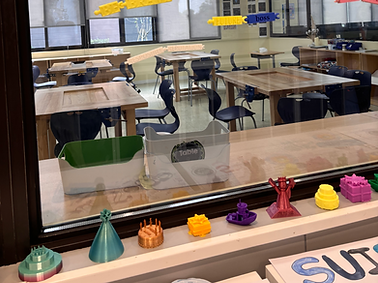
3D printing: Students will learn how to prepare their designs for the 3D printing. In a group of 5 students they will 3D print the already prepared 3D design with a birthday theme. Later in pairs they will output their word blocks as a final product.
They will experiment with different settings and material color.
Presentation and Reflection: Students will showcase their completed word-blocks and discuss the design process, the challenges they faced, and the lessons they learned. They will also reflect on how the integration of CAD and CAM techniques has enabled them to create a unique product.
Students will be able to
- Develop their skills in CAD and CAM, while also fostering their creativity, problem-solving abilities, and appreciation for the design process.
- Engage in a meaningful and authentic learning experience that connects their design work to their school community by creating word blocks (words associated with their school culture) and birthday themed products to celebrate the birthday of SUISQP. Analyze the roles of brand identity and brand image.
- Experiment with CAD and CAM software and tools, learn and apply these knowledge in future design units.
- Create a meaningful, unique product by integrating CAD and CAM techniques.
- Effectively showcase the product, provide and receive constructive feedback.
- Follow safety precautions at all stages when working with CAM.
Multidisciplinary theme: Design technologies (CAD, CAM (laser cutting/engraving)), design thinking, project management, art

Guiding Question(s) and/or Real-World Connections
-
What are the key elements of our school's culture and other distinctive features?
-
How can we incorporate the knowledge about our school’s culture into the 3D design to celebrate our school's birthday?
-
How can we use tinkercad to design word blocks?
-
What techniques can we employ to ensure our design is optimized for 3D printing?
-
What settings and techniques do we need to consider when preparing 3D designs for the 3D printer output?
-
What safety precautions and best practices should we follow when operating the 3D printer?
-
How can we effectively showcase our completed product and share the design process with our peers and the school community?
-
What lessons have we learned throughout this design technology unit, and how can we apply these learnings to future design projects?
-
How has the integration of CAD and CAM techniques impacted our ability to create a unique and personalized product?
Overacrhing goals
Develop CAD and CAM Skills:
- Provide students with the opportunity to practice and refine their skills in computer-aided design (CAD) using Tinkercad (17 tutorials)
- Introduce students to the workflow of computer-aided manufacturing (CAM) by utilizing a 3D printer and printing with a group of 5 a sample product (related to birthday theme) before printing their final product.
- Encourage students to explore the capabilities and limitations of CAD and CAM tools, and how to optimize their designs for these manufacturing processes.
Foster Creativity and Design Thinking:
- Challenge students to develop a design of word blocks (words of tehir choice related to school culture)
- Encourage students to engage in the design process, including ideation and iterative refinement, to create a final product - word blocks.
- Promote students' creativity and problem-solving skills as they navigate design challenges and make decisions throughout the project.
Enhance Project Management:
- Require students to plan and manage their time effectively to complete the various stages of the project, from design to manufacturing and assembly.
- Develop students' colaboration, communication, and presentation skills as they showcase their completed product and share their design process with their peers and the school community.
Promote Technological Literacy and Safety Awareness:
- Expose students to the practical applications of CAD and CAM technologies in the design and manufacturing of products.
- Demonstrate safety precautions at all stages when working with CAM.
Connect to Real-World Applications:
- Provide students with a meaningful and authentic learning experience by challenging them to create a product that celebrates their school's identity and history.
- Demonstrate the relevance of design technology skills in various industries and applications, beyond just academic settings.
- Encourage students to see the practical applications of their learning and how it can be applied to solve real-world problems or create tangible products.
